

You have a week, a box of photographs, some voicemails you cannot bring yourself to play, and five minutes to fill in front of everyone who knew them.
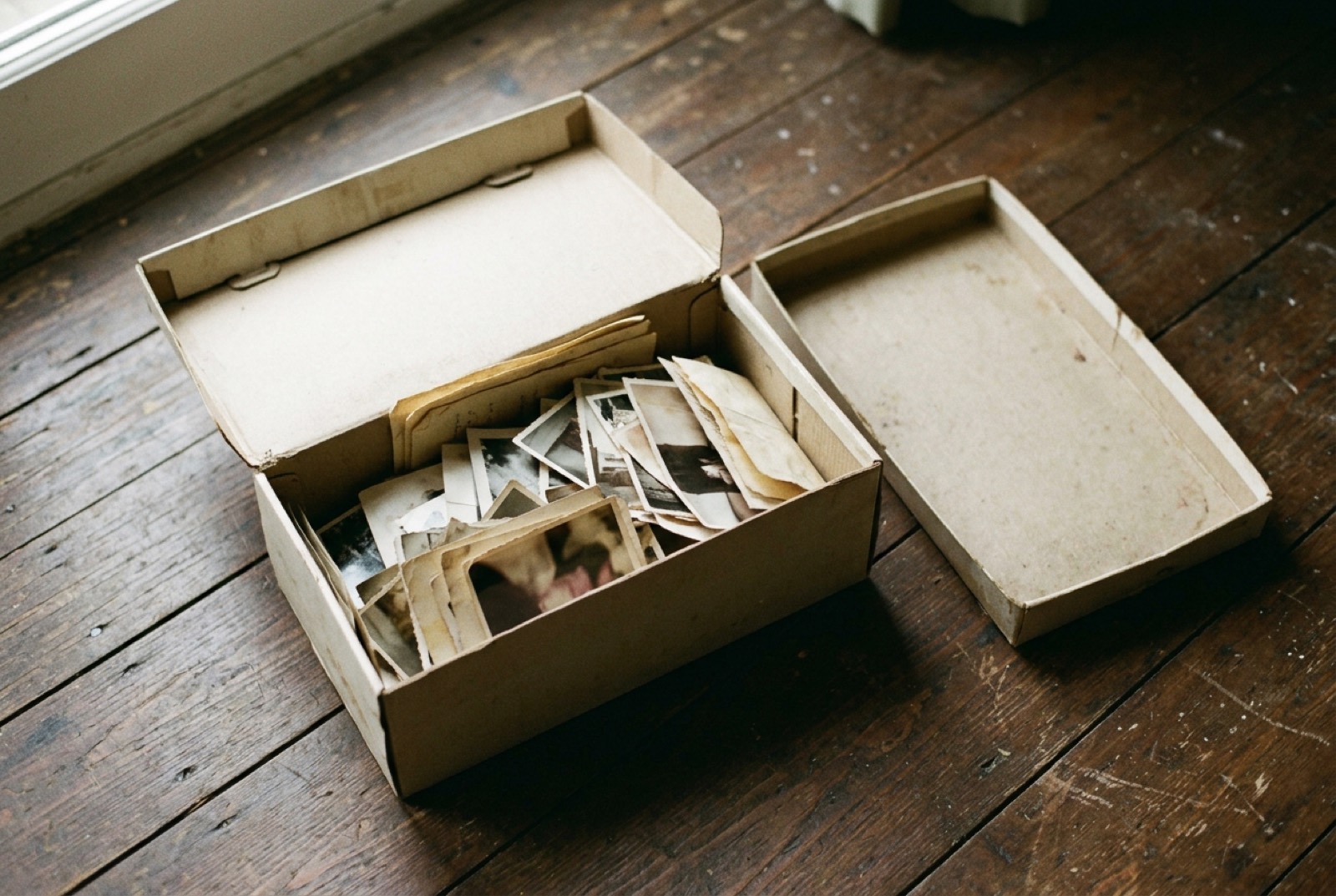
Do not start with a blank page and try to sum up a life. Start with the material you already have, photographs, letters, paperwork, old voice notes and what other people remember, pull eight or ten concrete things out of it, and build the five minutes from those. Specific beats comprehensive, every time, and the material does most of the work if you let it.
If this is why you are here
- The funeral is in a few days and you have five minutes to fill.
- There is a pile of material and you do not know where to start.
- You do not want to stand up and describe somebody smoother than they were.
Why the blank page is the wrong place to start
Almost everybody starts by trying to say what the person was like. Kind. Hard working. Devoted to her family. Always had time for anyone.
Every one of those sentences is true of the person, and none of them is only true of the person. That is why they are hard to write and harder to listen to: the room has heard them before, at other funerals, about other people.
The alternative is not to be cleverer. It is to start from the material instead, because the material is specific by nature. A works outing photograph from 1968 has three facts in it that no adjective will ever carry.
What you probably already have
More than you think, and most of it is within reach this week.
- Photographs, including the unlabelled ones. Turn a few over: people wrote on the back, and a date and a place is a sentence.
- Paper. Letters, cards, certificates, service records, payslips, a rent book, the order of service from somebody else’s funeral. Admin dates a life precisely.
- Anything with a voice in it. Voicemails, videos, voice notes on a phone. You do not have to listen to them yet. Secure them first, because this is the material that vanishes when a phone contract is cancelled, and that is often within weeks.
- Other people’s memories. Siblings, cousins, neighbours, the man he worked with for twenty years. This is the richest source and the one people forget, because they assume the job is theirs alone.
The method, if you have a week
Day one: gather, do not write. Everything in one pile on one table. Resist deciding what it means.
Day two: pull out ten concrete things. Not qualities. Things. A job, a car, a street, a phrase she always used, a row that became a family joke, what he did every Sunday without fail, the thing he was unreasonable about. Write each as one flat sentence with no adjectives in it.
Day three: ring three people and ask one question. Not “what do you remember about Dad”. Ask “what was he like at work”, or “what was she like before we came along”. A narrow question gets a real answer; a wide one gets a tribute.
Day four: pick four of the ten. Four is the right number for five minutes. Arrange them so they are not chronological, because a life told as a timeline is the version everybody expects and stops listening to.
Day five: write it once, out loud. If a sentence is hard to say standing up, it is the wrong sentence. Read it to one person who knew them. They will tell you which bit is the real one.
Leave the summing up until last, if you do it at all. Often the fourth story does the summing up on its own and anything added afterwards weakens it.
Using a recording without it undoing you
If there is audio of them, it is worth listening to, and it is worth doing it with somebody else in the house.
Two practical things. Do not try to transcribe a whole recording in the week of a funeral: skip through it and note timings for anything that makes you sit up. And if you want to play a clip at the service, check it with whoever is running things, because a recording of somebody’s actual voice in a crematorium lands harder than anyone expects, on you as much as on the room.
If the recording has other family in it, and it usually does, ask them before you play their part of it to a room. That is courtesy rather than law, and it is the kind of thing that causes a rift at a funeral if it is skipped. Your recordings and your privacy covers it properly.
When the family remembers it differently
This surfaces fast when a eulogy is being written, because somebody always reads a draft and says that is not how it happened.
Usually both versions are honest. The useful move is not to arbitrate but to choose the version that belongs to whoever is speaking: you are giving your account of them, not the official one. If the disagreement is bigger than that, when the family remembers it differently goes through it properly.
What not to do
Do not read out their CV. Dates of employment are not a life.
Do not apologise for your writing or your crying. Nobody in that room is assessing you.
Do not try to include everybody. A eulogy that mentions all fourteen grandchildren by name is a list. If you must, one line at the end covers it.
Do not smooth over who they actually were. The awkward, funny, difficult bits are what makes the room recognise them. Of the eulogies I have sat through, the ones that did not land were the ones describing somebody smoother than the person had been.
Afterwards
A eulogy is five minutes, and for a lot of families it turns out to be the only time anybody ever wrote any of it down.
The material you gathered this week is now sitting in one place for the first time, which is the hard part of a proper written story and the part most families never get to. There is no rush at all on deciding whether to do anything with it. But do not disperse it back into three houses and a loft: keep it together, label what you can while people still remember, and decide in a year.
Building a story from what is left is what that would look like if you ever wanted it.