
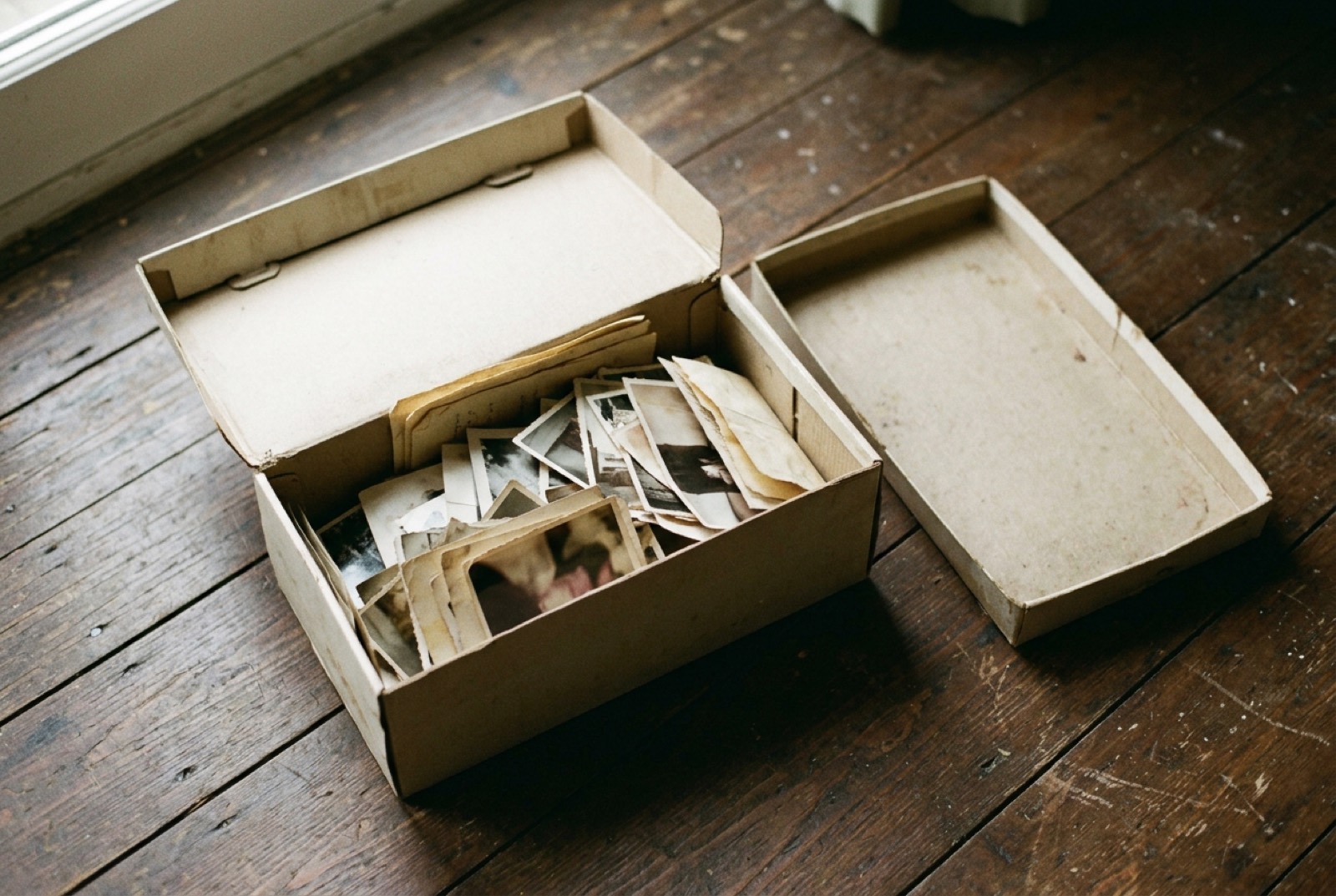
They have gone, nobody recorded anything, and what you have is a box of photographs, some paperwork and everyone's different memories. That is more than it sounds.
You can still make something worth keeping. The material most families think is not enough, photographs, letters, documents, a few recordings and what people remember, is usually enough for a real story, as long as the finished thing is honest about what is known and what is not. Start by gathering rather than deciding.
If this is why you are here
- They have gone and nobody recorded anything.
- What you have is a box of photographs, some paperwork and everyone's different memories.
- You think it is probably not enough.
Do the gathering before the deciding
The instinct is to work out what the finished thing should be. Do the opposite. Gather first, decide later, because what you find changes what is possible.
Gathering, in practical order:
- Anything with a voice in it. Voicemails, videos, voice notes. These are the most fragile and the most easily lost when a phone contract is cancelled or an account closed. Do this first, today if you can.
- Photographs, including the ones nobody has labelled.
- Paper. Letters, cards, certificates, service records, work papers, the contents of the drawer everyone avoids.
- What people remember. Siblings, cousins, neighbours, old colleagues. Write it down or record it while people are still in touch, which after a death is a window that closes faster than anyone expects.
Do not throw anything away at this stage, including the things that look like admin. A payslip, a rent book or a works outing programme dates a period of somebody’s life precisely.
If the funeral has not happened yet, most of the above is also the work of writing the eulogy, and doing it once serves both. Writing a eulogy from what they left behind is that week on its own.
What is usually enough
Families underestimate what they have, because they are comparing it to an interview that never happened.
A useful measure: if you can answer roughly where they were, who they were with, and what they were doing across four or five stretches of their life, there is a story there. The rest is detail that other people can fill in, and detail is what conversations with family are for.
What genuinely cannot be reconstructed is what they thought about it. That is the loss, and it is better to be clear-eyed about, because the honest version of the finished story says “he never talked about it” rather than inventing an inner life.
The gaps
Every story built after a death has gaps. What matters is how they are handled.
Say so. “Nobody knows where he was between 1947 and 1949” is a better sentence than a smooth guess, and it is the sentence that occasionally gets answered years later by a cousin who reads it.
Do not invent joins. It is tempting, and it is the thing that makes a family stop trusting the book.
Record the disagreements. If two of you remember the same event differently, both versions can go in. That is often truer than picking one, and it is the bit grandchildren find most interesting.
Leave room. A story that admits what it does not know can be added to later. A polished one cannot.
The order it tends to take
Not always chronological. When the material is patchy, a life told through places, or through work, or through a handful of objects, usually reads better than a timeline with holes in it.
That is a decision to make once you can see everything, which is another reason to gather first.
Timing
There is no deadline on deciding what to make. There is a deadline on the material.
Phones get wiped, accounts get closed, houses get cleared, and the neighbour who knew him at work moves away. Secure what exists now, then take as long as you want over the rest. Some families do this within months. Some do it on the first anniversary, or for a parent’s 80th, or when a grandchild asks a question nobody can answer.
If you would like it written properly
This is a normal starting point for the work I do, not an unusual one.
Tell me what you have: roughly how many photographs, whether there is any paperwork, whether anyone recorded anything, and who else is still around to ask. I will tell you honestly whether there is a book in it, something shorter, or whether you are better off simply organising what you have and writing it yourself.